Knut Knutson Berge by Roger Sween, June 3, 2009.
K. K. Berge, as he styled himself, was born July 22, 1875, in the parish of Vang in Valdres, Norway. He apprenticed as a tailor while a teenager and by family accounts longed to emigrate to the United States. He was able to do this, likely due to the assistance of his cousin, Henry Weflen, who previously settled in Granite Falls.
K. K. came to the United States through Canada on the St. Lawrence River, landing at Sault Ste. Marie, December 1896. He was 21 years old. He tailored first with Weflen in Granite Falls and later in Benson, Minnesota, where there was a shortage of tailors. In Benson, he met Louisa/Louise Fretland (1878-1962) who had emigrated separately from Bergen, Norway at age 18. After their marriage, K. K. returned to Granite Falls, traveling between Benson and Granite by bicycle. Louise followed in the spring.
K. K. was eager to become a citizen, accomplished February 7, 1902. At this time the Berge's had two daughters - Anna, born 1899 and Lelle, born 1901 (Mrs. Gordon C. Sween). Cora, deceased at 14 years, Juliet (Mrs. Carl Barthelemy), and Odin C. Berge followed.
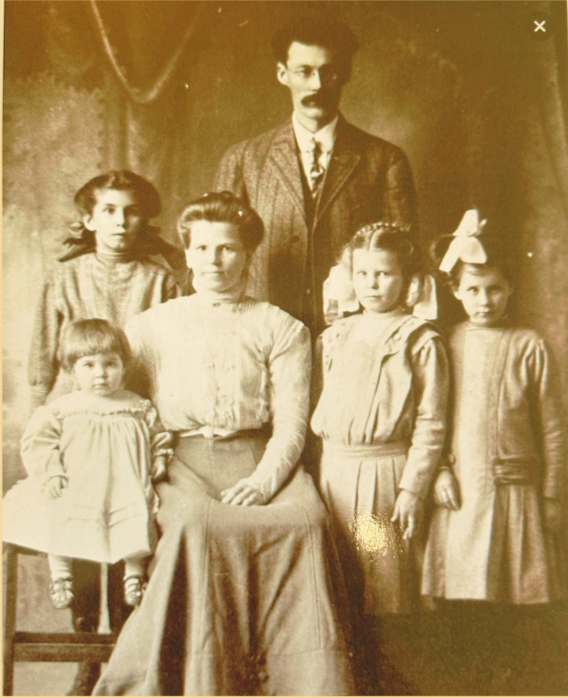
K. K. actively participated in church and civic life. He was Sunday School Superintendent, a church council member, and served on the Board of Home Missions for the Lutheran Church. He also served on the Granite Falls volunteer fire department, terms on the City Council in 1915, 1916 and 1933-1935 and one term as mayor in 1936. K. K. ran once for Yellow Medicine County Commissioner but was defeated. That was the end of elective office for him, but he did serve on Federal grand juries, travelling by train from Granite Falls to St. Paul. He was a progressive in politics, an admirer of Robert Lafollette of Wisconsin, and voted accordingly.
K. K. built the Berge Building in a prominent location near the footbridge and across from the Opera House and Yellow Medicine County Bank. He operated for several years a dry goods store of fabrics and ready-made clothes along with his tailoring of altered and custom-made clothes. His children reported that while young one of their tasks was to go to his shop and thread needles for him. One advertisement lists men's handmade suits at $15.00.
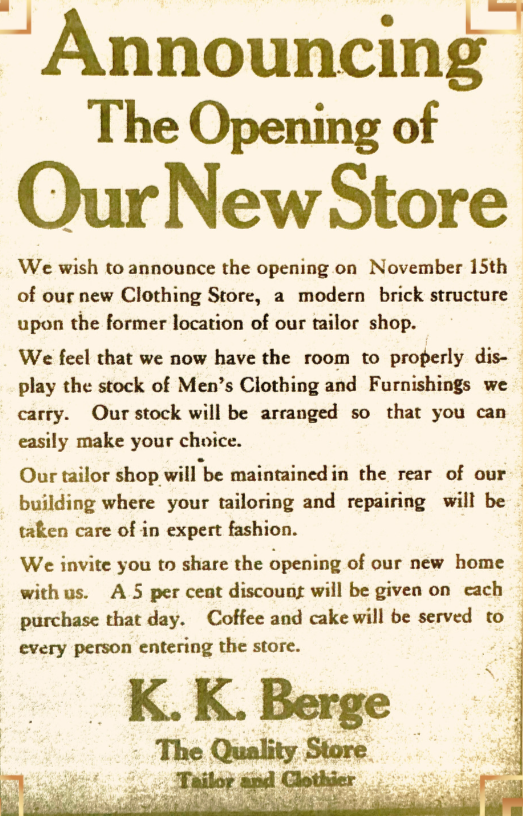
The Berge Building also housed the millinery shop of the Andersen Sisters. I remember it as a very long, narrow location that operated until the sisters retired. Besides apartments on the upper floor, Dr. Taylor had his dental practice there for several years before moving to a ground level location on Prentice Street. In later years, K. K. quit the dry goods business and rented his space to Korthuis Jeweler. He still maintained a tailor shop in the basement where he did a modest amount of business, but mostly it served as a gathering spot for him and his cronies where they could continue to argue over religion, politics, and other community matters.
Grandpa Berge made all my suits that I had from confirmation onwards to the first years of college. Though his hands trembled, he remained fastidious and always took great pride in the quality of the textiles and his own workmanship.
K. K. made four return trips to Norway, the first when the Berge children were young, the last by himself in 1951. He had not been to Norway since prior to WW II and found it considerably changed. "I know now I am an American," he said to the Barthelemys upon his arrival at O'Hare airport.
After his death, November 19, 1957, Louise Berge lived in an apartment of the building until her death. Subsequently Korthuis bought the building. My father, Gordon C. Sween, in the years that he managed the Minneapolis Star & Tribune delivery routes, operated out of what had been K. K.'s last shop in the basement. He installed an outside door for the carriers that faced on the alley behind the building and the Minnesota River. I remember my father going down one time to nail the door shut when floodwaters threatened the building in the late 50s or early 60's.
